
Traditional Jewish funeral customs are rooted in the teachings and beliefs of the Torah. Both simple and solemn, Jewish funerals are centered around honoring the deceased and providing comfort to the bereaved. While the fundamental beliefs remain consistent across the various branches of Judaism – Orthodox, Conservative, Reconstructionist, and Reform – specific practices can vary.
In this blog, we discuss traditional Jewish funeral customs, providing a helpful guide on their practices and how these ceremonies provide comfort and healing during times of loss.
Before the Funeral
In Judaism, death is viewed as a natural part of life and traditional Jewish funeral customs are centered around the teachings that the body should be returned to the earth. They also practice Kavod Ha-Met, or honoring the dead, which says that the body must be treated with the utmost respect.

According to Jewish law, the burial should take place within 24 to 48 hours after death. In modern times, there has been more flexibility to accommodate preparations for the services and family members who may have to travel. Another traditional Jewish funeral custom is the shemira, where a member of the Jewish faith or close family member watches over the body until burial. The designated person who stays with the body is known as the shomer.
To prepare for burial, the individual is washed in a ritual act of purification, known as tahara, and then wrapped in a white linen shroud. Men are often buried with a prayer shawl over the shroud, called a tallit. Embalming is not allowed as it disrupts the body’s natural decomposition process. Additionally, tradition calls for an unadorned wooden casket to aid in the body’s natural return to earth. In the Jewish faith, all people are considered equal in death so ornate caskets and colorful decorations are avoided.
During the Funeral
Jewish funerals are simple ceremonies designed to foster communal mourning for the deceased. These services do not take place on holidays or on the Sabbath. They are meant to be short, solemn and unembellished. The funeral can take place in a synagogue, funeral home, or graveside. To respect and honor the dead, there is no public viewing of the body and the casket remains closed. The funeral is typically led by a rabbi along with psalms, prayers, and memories shared by loved ones. Music and flowers are typically prohibited in Jewish funerals.
As a sign of love and respect, Jewish tradition encourages family and friends to participate in the burial process. Those who attend the graveside services often shovel dirt onto the casket as a symbolic way to say goodbye.
After the Funeral
 Following the burial, Jewish families observe shiva – a seven-day mourning period traditionally held at the home of a close relative. During shiva, family and friends offer condolences and support as the bereaved focus on healing and remembrance of the departed. A candle is lit on the first day of shiva and left to burn throughout the mourning period.
On the one-year anniversary of the passing, a Yahrzeit candle is lit and left to burn for 24 hours to honor the departed.
For Attendees
What to Wear
Jewish funeral dress attire should be respectful and modest. Black or dark suits, dresses and business attire are recommended. Men from the Jewish faith will also wear a head covering known as a yarmulke. Additionally, close family members will also wear a black ribbon that is ceremoniously torn before the funeral service, also known as the kriah, and worn throughout the mourning period to symbolize the loss of a loved one.
 What to Bring
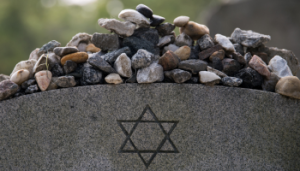
In traditional Jewish funeral customs, flowers are not considered appropriate gifts for the bereaved. Flowers typically represent a celebration and can distract from properly grieving. An ancient practice in Judaism is to leave small pebbles or stones on the burial site. This act represents the permanence of memory and, unlike flowers, stones last forever. In lieu of flowers, guests are encouraged to donate to a charity close to the deceased or bring food, known as kosher, for the family.
Traditional Jewish Funeral Customs at Coastal Funeral Center
Our team at Coastal Funeral Center celebrates the symphony of life and cultures of all. We provide culturally sensitive funeral services that honor the diverse traditions of our community. Whether you’re planning a funeral or attending as a guest, we’re here to assist you every step of the way.
You may also find these of interest:
- The Samoan Farewell: Understanding Samoan Funeral Traditions
- Navigating Filipino Funeral Traditions
- Understanding Latter-Day Saints Funerals
About Coastal Funeral Center
At Coastal Funeral Center, we are committed to being dedicated guardians of family and community, while holding on to the legacy we established as a family-owned funeral home. Originally A.M Gamby Funeral Home, Coastal Funeral Center joined Green Hills in 2018 to better serve the community of the South Bay and Palos Verdes Peninsula. During this transition, we expanded our services as an all-inclusive facility and built on the successes of Green Hills Memorial Park. We’re proud of our legacy of personal service and our deep roots in the community, which we’ve been part of for more than 80 years. We provide customized funeral service options that meet your financial needs and honor your loved one. To learn more, visit https://coastalfuneralcenter.com/about/


